
Understand the detection methods and certification standards of degradable plastics at home and abroad
Biodegradable plastics refer to a class of plastics that are degraded by the action of naturally occurring microorganisms such as bacteria, molds (fungi) and algae.
Biodegradable plastic is a kind of polymer material with excellent performance, which can be completely decomposed by environmental microorganisms after waste, and finally become an integral part of the carbon cycle in nature. "Paper" is a typical biodegradable material, while "synthetic plastic" is a typical polymer material. Therefore, biodegradable plastics are polymer materials with the properties of both "paper" and "synthetic plastics".
The difference between degradable and biodegradable plastics
Degradable plastics is a large category, including photodegradable, thermal degradable plastics and biodegradable plastics, biodegradable plastics is only one of them, but it can be biodissolved into carbon dioxide (or methane) and water under natural environment, compost and other conditions.
The difference between biobased /C14 and biodegradation
Biodegradation is a concept mainly proposed from the perspective of environmental absorption performance after plastic waste.
Biobased is a concept from the perspective of raw material source.
Biodegradable plastics can become carbon dioxide and water under certain conditions after use, and the raw materials of biodegradable plastics are mainly renewable resources such as starch, cellulose and so on. Although most biobased plastics are biodegradable, biobased plastics are not necessarily biodegradable, and biodegradable plastics are not necessarily biobased plastics.
Biodegradability is an important property of PBS polyester. At present, the main method to evaluate the biodegradability of plastics in the world is composting, which contains rich microbial sources and can reflect the biodegradability of plastics in the natural environment to a certain extent.
The difference between biodegradable plastics and compostable plastics
Biodegradable plastics refer to some plastics that can be dissolved into carbon dioxide and water in the natural environment, or composting conditions, or soil conditions, or high solid state, etc. In addition to the material requirements to become carbon dioxide and water, the latter also requires that the plastic can become small pieces less than 2cm in size during the composting cycle. It is also required that the heavy metal content of compost produced by compost should meet the standard requirements of various countries, and compost will not have adverse effects on the growth of plants compared with traditional compost.
Since the beginning of the century, protecting the earth, building a resource-recycling society, and taking the road of sustainable development have become the focus of attention and urgent tasks of the world. Biodegradable plastics, as a supplement to replace the limited, diminishing and increasingly depleted non-renewable petroleum resources, have also become a development trend of global attention. From 2008 "plastic limit" to 2020 "plastic ban", China clearly put forward the "timetable" to further strengthen plastic pollution control, focusing on the construction of the overall plastic cycle industry chain. Put forward the construction of plastic recycling management system and steps, from different levels of strength, supporting supervision, policy and scientific and technological research and development also have a more comprehensive framework and system planning.
But so far, standards for biodegradable plastics have been lacking, Today, I will introduce some existing detection methods and standards for biodegradable plastics at home and abroad that can be followed and used for reference, as well as biodegradable plastics certification bodies (DIN CERTCO Standardization Certification Center in Germany), AIB-Vincotte(Belgium), OK biobased and BPI (American Institute of Biodegradable Plastics) and related certification needs attention.
Detection methods and standards for biodegradable plastics in China
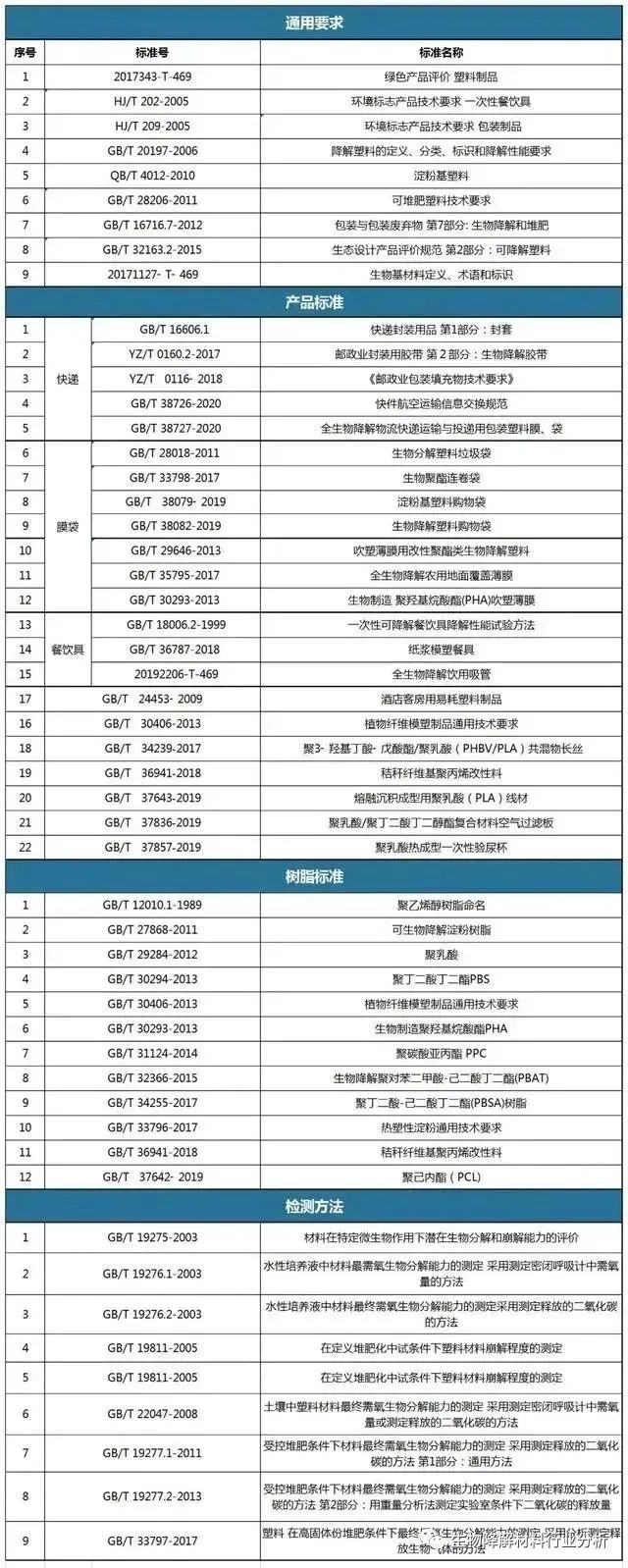
Foreign biodegradable plastics certification bodies and certification related precautions and requirements
A list of product certification bodies
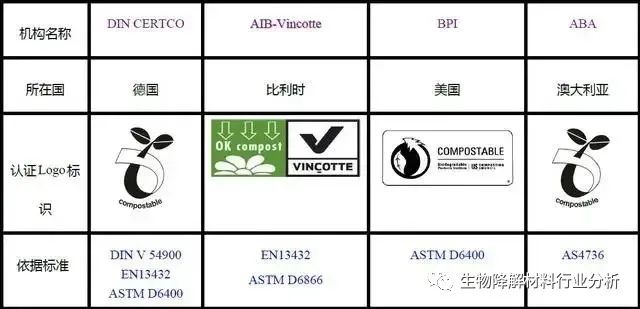
DIN CERTCO(Certification Center of the German Institute of Standardization)
1, according to the standard
- The European Committee for Standardization (CEN)- "The European Committee for Standardization"
- EN13432-2000 "Package-Requirements for recycling by composting and biodegradation-Test plan and evaluation criteria for final acceptability of package-"
- American Society for Testing and materials (ASTM)- "American Society for Testing and Materials"
- ASTM D6400-2004 Specification for Compostable Plastics
- German Institute for Standardization (DIN)- "Deutsches Institut fur Normung e. V."
- DIN V 54900 "Testing Biodegradability of biodegradable plastics by composting experiments"
Logo
2. Test item (EN13432)
- Biodegradability test (based on ISO14855 "Determination of final aerobic biodegradability of plastic materials under controlled composting environment - Incremental carbon dioxide analysis")
- Disintegration rate test during composting (test according to ISO16929 "Plastics - Determination of decomposition of plastics under laboratory defined composting pilot conditions")
- Ecological non-toxicity test (also known as "plant planting test"); Test basis: Organization for Economic Cooperation and Development (OECD) OECD208 Guideline "Land Plant Growth Test")
- Heavy metal content test (11 kinds of heavy metals such as: arsenic, cadmium, copper, lead, mercury, nickel, selenium, zinc, chromium, cobalt, molybdenum are not allowed to exceed the standard)
3. Scope of application of certificate
- Applicable region: Europe
- Countries of focus: Austria, Belgium, Czechoslovak Republic, Denmark, Finland, France, Germany, Greece, Iceland, Ireland, Italy, Luxembourg, Netherlands, Norway, Portugal, Spain, Sweden, Switzerland and the United Kingdom
4. biodegradable plastic certification
- Required information: application form, product composition ratio information, test report
- Certification time: 4 to 6 weeks (with complete information)
- Certification fee: EUR2,200.00~EUR2,500.00
- Certificate validity: from the date of issue, valid indefinitely (pay EUR215.00 certificate management fee per year)
5. biodegradable plastic products certification
- Required materials: application form (product composition ratio information, including whether it contains pigment additives, ink color and printing specific gravity ratio), heavy metal detection report of pigment and ink, MSDS(chemical safety technical manual) of ink, infrared spectrum analysis and detection report of finished product
- Certification time: 4 to 6 weeks (with complete information)
- Certification fee: EUR2,700.00~EUR3,000.00
- Certificate validity: valid for 3 years from the date of issue (EUR215.00 certificate management fee per year)
6. Precautions
- The thickness of the sample directly affects the maximum thickness of the certified product
- Certified products must be recertified if there is a significant change in the composition ratio
- Type and color of ink used for certification of biodegradable plastic products
AIB-Vincotte(Belgium)
1. according to the standard
- The European Committee for Standardization (CEN)- "The European Committee for Standardization"
EN13432-2000 "Package-Requirements for recycling by composting and biodegradation-Test plan and evaluation criteria for final acceptability of package-"
American Society for Testing and materials (ASTM)- "American Society for Testing and Materials"
- ASTM D6866-2004 "Test Method for Determining Biological Content of Solid, Liquid, and Gas Specimens by Radiocarbon Analysis"
Logo
EN13432 for home composting systems

EN13432 for commercial composting systems

ASTM applies to bio-based materials
2. Test item (EN13432)
- Biodegradability test (based on ISO14855 "Determination of final aerobic biodegradability of plastic materials under controlled composting environment - Incremental carbon dioxide analysis")
- Disintegration rate test during composting (test according to ISO16929 "Plastics - Determination of decomposition of plastics under laboratory defined composting pilot conditions")
- Ecological non-toxicity test (also known as "plant planting test"); Test basis: Organization for Economic Cooperation and Development (OECD) OECD208 Guideline "Land Plant Growth Test")
- Heavy metal content test (11 kinds of heavy metals such as: arsenic, cadmium, copper, lead, mercury, nickel, selenium, zinc, chromium, cobalt, molybdenum are not allowed to exceed the standard)
- Please see "Test Report" for details.
- ASTM D6866-2004 "Test Method for Determining Biological Content of Solid, Liquid, and Gas Specimens by Radiocarbon Analysis"
- Determine the amount of the "radioisotope carbon 14" in the material to determine the amount of biomass
3. Scope of application of certificate
- Applicable region: Eastern Europe, Western Europe
- Countries of focus: Belgium, France, Italy, Luxembourg, Netherlands, Hungary, Slovak Republic
4, biodegradable plastic certification
- Required information: application form, product composition ratio information, test report
- Certification time: 4 to 6 weeks (with complete information)
- Certification fee: EUR2,900.00~EUR3,000.00
- Certificate validity: 20 months from the date of issue (EUR1,277.00 certificate management fee per year)
5, biodegradable plastic products certification
- Required materials: application form (product composition ratio information, including whether it contains pigment additives, ink color and printing specific gravity ratio), heavy metal detection report of pigment and ink, MSDS(chemical safety technical manual) of ink, infrared spectrum analysis and detection report of finished product
- Certification time: 4 to 6 weeks (with complete information)
- Certification fee: EUR2,500.00~EUR3,000.00
- Certificate validity: 20 months from the date of issue (EUR1,277.00 certificate management fee per year)
6. Precautions
- The thickness of the sample directly affects the maximum thickness of the certified product
- Certified products must be recertified if there is a significant change in the composition ratio
- Type and color of ink used for certification of biodegradable plastic products
OK biobased
American Society for Testing and materials (ASTM)- "American Society for Testing and Materials"
• ASTM D6866-2004 "Test Method for Determining Biological Content of Solid, Liquid, and Gas Specimens by Radiocarbon Analysis"
Certification was first introduced for materials in September 2009 and expanded to include finished products from January 2010
• Logo

One star biomass content of 20%-40%

Two-star biomass content 40%-60%

Three-star biomass content 60%-80%

The four-star biomass content is more than 80%
BPI (American Biodegradable Plastics Institute)
(BPI)---“The Biodegradable Products Institute”
1, according to the standard
American Society for Testing and materials (ASTM)- "American Society for Testing and Materials"
• ASTM D6400-2004 Specification for Compostable Plastics
Logo
ABA(Biodegradable Plastics Association of Australia)
(ABA)---“The Australasian Bioplastics Association”
1, according to the standard
Australian Standards Organisation (SA)- "Standards Australia"
AS4736-2006 "Packaging - Requirements for Packaging to be recycled by composting and biodegradation - Test plan and evaluation criteria for final Acceptability of Packaging"
EN13432-2000 "Packaging - Requirements for Packaging to be recycled by composting and biodegradation - Test Plan and evaluation Criteria for Final Acceptable Packaging" + OECD OECD207 Guidelines "Toxicological Testing of Earthworms"
• Logo
2. Test items (AS4736-2006)
- Biodegradability test (based on ISO14855 "Determination of final aerobic biodegradability of plastic materials under controlled composting environment - Incremental carbon dioxide analysis")
- Disintegration rate test during composting (test according to ISO16929 "Plastics - Determination of decomposition of plastics under laboratory defined composting pilot conditions")
- Ecological non-toxicity test (also known as "plant planting test"); Test basis: Organization for Economic Cooperation and Development (OECD) OECD208 Guideline "Land Plant Growth Test")
- Heavy metal content test (11 kinds of heavy metals such as: arsenic, cadmium, copper, lead, mercury, nickel, selenium, zinc, chromium, cobalt, molybdenum are not allowed to exceed the standard)
- Earthworm toxicology testing (testing based on the OECD OECD207 Guidelines "Earthworm Toxicology Testing")
3. Scope of application of certificate
- Applicable country: Australia, New Zealand
- Country of focus: Australia
4. biodegradable plastic certification
- Required information: application form, product composition ratio information, test report
- Certification time: 4 to 6 weeks (with complete information)
- Certification fee: AUS700.00~AUS1,200.00
- Certificate validity: 2 years from the date of issue
5. biodegradable plastic products certification
- Required materials: application form (product composition ratio information, including whether it contains pigment additives, ink color and printing specific gravity ratio), heavy metal detection report of pigment and ink, MSDS(chemical safety technical manual) of ink, infrared spectrum analysis and detection report of finished product
- Certification time: 4 to 6 weeks (with complete information)
- Certification fee: AUS700.00~AUS1,200.00
- Certificate validity: 2 years from the date of issue
6. Precautions
- The thickness of the sample directly affects the maximum thickness of the certified product
- Certified products must be recertified if there is a significant change in the composition ratio
- Type and color of ink used for certification of biodegradable plastic products
Other certification bodies
Jatelaito Syhdistys
Japan Bioplastics Association (JBPA)- "Japan Bioplastics Association"
Logo